Every award rule has a price. It just never appears in any bid.
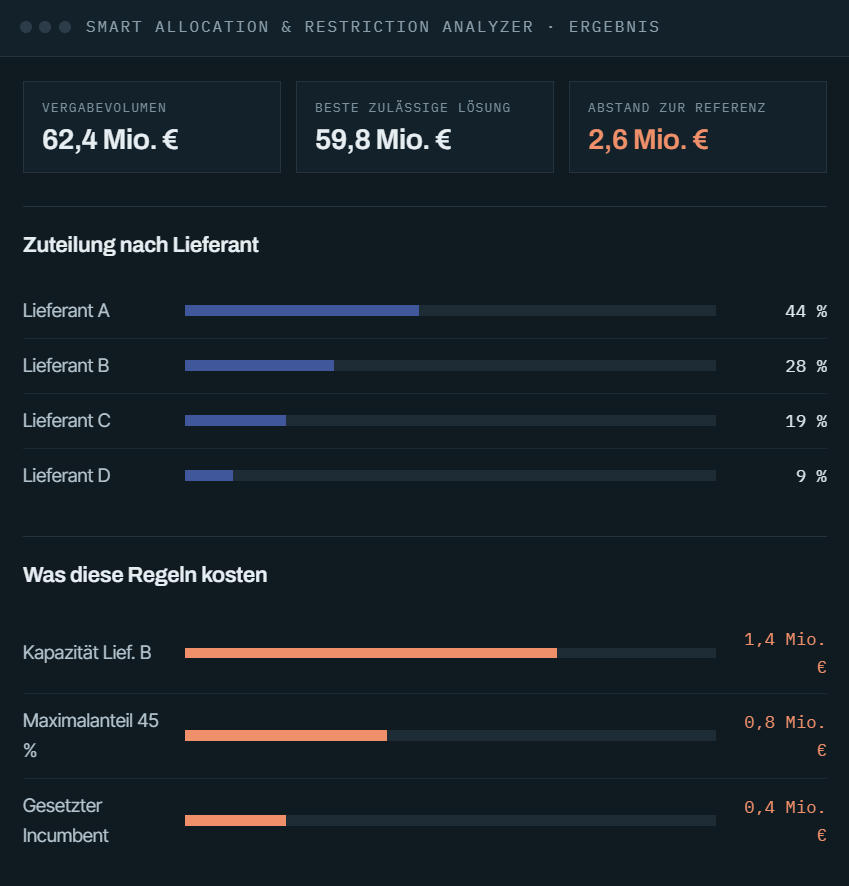
What does the quota that caps a single supplier’s share at 45 percent cost you? And which supplier would only need to commit a little more capacity to make a significantly better result possible? The software calculates the best feasible allocation of your lots and shows in euros how much each of your own requirements costs you. Before the award, you see which decision really pays off.
Trusted by















Prices are negotiated down to the decimal point. Your own requirements never are.
Every major contract award comes with rules: a maximum share per supplier, a capacity limit, an approval, the preset incumbent supplier. These rules are treated as a given. Yet they often cost more than the next percentage point on price. It’s just that nobody calculates it.
Rules are considered non-negotiable
Requirements from business units, plants or past practice are rarely questioned, because nobody can put a figure on what they actually cost.
The better solution stays invisible
You see the result that was possible under all the rules. You don’t see what result would have been possible without a particular rule.
Excel reaches its limits
As soon as multiple lots, tiered prices, capacities and additional constraints come together, the best allocation can no longer be calculated by hand.
The allocation, the cost and the reason for the gap.
- The best feasible result Which supplier gets which lot in which volume, under all applicable requirements.
- The gap to the optimum How much cheaper the award would be without restrictions, and which rule causes this difference.
- Transparent for the committee Every figure can be traced back to a specific requirement. That makes the decision justifiable internally.
From bids to a well-founded award decision.
Establish a benchmark
The software imports the bids and calculates how cheap the award would theoretically be without any restrictions at all. This is the yardstick for everything that follows.
Model your rules
Quotas, capacities, approvals, revenue limits, bonus and malus rules are captured. Unspoken assumptions thus become visible decisions.
Attribute costs
The software calculates the best feasible solution and shows which individual requirement causes the largest gap to the benchmark.
Play through alternatives
Relax rules, increase capacities, block or fix lots: every change is recalculated instantly. This shows you which intervention pays off most.
Six building blocks that work together.
Optimal allocation
The software calculates the most cost-effective feasible distribution across all lots, bidders and volumes. Even when hundreds of combinations are possible.
Rules and restrictions
Internal and external requirements are captured explicitly. A seemingly fixed rule becomes a decision whose price you know.
Identify cost drivers
An overview shows how much each requirement costs you. You immediately see which rule is worth discussing again.
Explore capacities
What happens if a supplier could deliver more? You see how much economic leeway lies behind it. That is your negotiation argument.
Bonus and malus
Quality, on-time delivery or strategic criteria are factored in as surcharges and discounts. The calculation stays economically sound without ignoring soft factors.
Compare scenarios
Baseline, strict rules, relaxed rules, changed capacities: you see side by side how costs and winners shift.
Shall we run the numbers on one of your contract awards?
savings on average. Not only because prices decrease, but because it becomes transparent how much each individual restriction actually costs. *Statistical analysis of the last 4 years: Average savings of 4% through an analysis of restriction costs prior to the award process, plus an additional average of 14% during the award process.
Let’s talk about your next contract award.
No standard demo with sample data. Name an upcoming contract award, and we’ll take care of the rest: in 45 minutes, we’ll show you on your own case what your rules cost and where the greatest potential lies.
Book a free demo